Human Beings of Peace
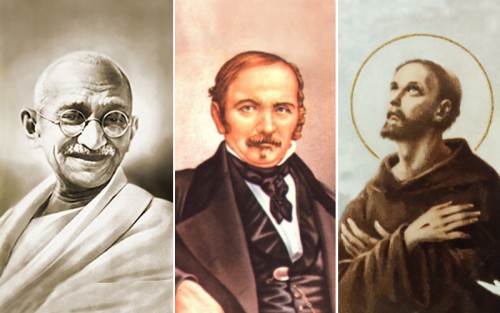
Source: Jornal de Brasília newspaper, Tuesday, October 2, 2012 edition | Updated in 2017.
Reprodução BV

Gandhi, Allan Kardec, and Saint Francis of Assisi

Due to the relevance of their contributions to us, I want to talk to you again about three significant figures of Humanity who are celebrated in early October: Mohandas Karamchand Gandhi (1869-1948), on the 2nd; Hippolyte Léon Denizard Rivail, better known as Allan Kardec (1804-1869), on the 3rd; and Saint Francis of Assisi (1181-1226), Il poverello, on the 4th; the latter is the patron of the Legion of Good Will (LGW). Each one, in their time and field of action, knew how to work hard in favor of Peace. Gandhi, an Indian lawyer, led the liberation of his people, preaching non-violence; Kardec, a French educator, codified the science of the Spirits for human rationale; Saint Francis of Assisi, a young Italian idealist, shared universal love with all the kingdoms of Nature.

They represent a great deal of what the world is so much lacking in: diplomatic perseverance in the general good, higher spirituality in daily actions, and complete charity that respects and protects without distinction. Let us learn the lessons they left us.

José de Paiva Netto (1941-2025), a writer, journalist, radio broadcaster, educator, composer, poet, the President Emeritus and Consolidator of the Legion of Good Will, and Spiritual Leader of the Religion of God, of the Christ, and of the Holy Spirit. He was an effective member of the Brazilian Press Association (ABI) and the Brazilian International Press Association (ABI-Inter), a member of the National Federation of Journalists (FENAJ), the International Federation of Journalists (IFJ), the Union of Professional Journalists of the State of Rio de Janeiro, the Union of Writers of Rio de Janeiro, the Radio Broadcasters Union of Rio de Janeiro, the Brazilian Union of Composers (UBC), and the Academy of Letters of Central Brazil. He became an internationally recognized author in the defense of human rights and in his concepts of Ecumenical Citizenship and Ecumenical Spirituality, which, in his own words, represent “the cradle of the most generous values that are born of the Soul, the dwelling of emotions and of reasoning enlightened by intuition; the atmosphere that embraces everything that transcends the ordinary field of matter and comes from elevated human sensitivity, such as Truth, Justice, Mercy, Ethics, Honesty, Generosity, and Fraternal Love. In short, the mathematical constant that harmonizes the equation of spiritual, moral, mental, and human existence. Now, without the understanding that we exist on two planes―not only on the physical plane―it will be difficult to build a Society that is truly Ecumenical, Altruistic, and Solidary, since we would still be ignoring that the knowledge of Superior Spirituality elevates the character of creatures and, consequently, leads to the construction of the Planetary Citizenship.”