Charity at the UN
The LGW’s representative at the UN, Danilo Parmegiani, informs us that the United Nations celebrated the International Day of Charity for the very first time. The recently approved resolution chose September 5 as the date for its observation.
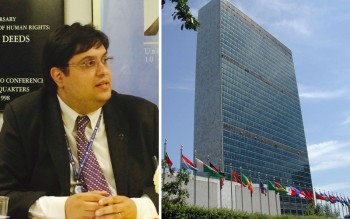
Danilo Parmegiani
The UN affirms that Charity may contribute to the promotion of dialogue among people from different civilizations, cultures and religions, as well as solidarity and mutual understanding, and it recognizes the efforts of charitable organizations and individuals in this respect.
Charity sustains human life
This is a topic that is always present in my articles, because I consider it to be essential for our survival. I take this opportunity to give you a preview of a small extract from “O Capital de Deus” [The Capital of God], a book I am very carefully preparing and in which I present some of the speeches I have given since the 1960s:

John
Let us meditate on this passage from John the Apostle in his First Epistle 4:20: “Whoever claims to love God yet hates his brother or sister is a liar. For whoever does not love their brother and sister, whom they have seen, cannot love God, whom they have not seen.”
Charity, which was created by God, is the feeling that keeps Beings alive at times of agony in their existence. If you tell me you don’t need Love, you are either mistaken or sick... In short, it is simply this: Love, which is synonym of Charity, is so lacking in our shortsighted society clouded by an insidious culture maintained by those who provoked all the woes that have bloodied the history of all peoples and that place us in constant danger. For how long?

Francisco de Assis Periotto
Charity sustains human life. When journalist Francisco de Assis Periotto heard these words of mine he added: “in bread and in decency”.
Exalted social spirit

Joaquim Nabuco
Technological advances have overthrown many frontiers and made some collapse onto others, among them economic and social frontiers. Nevertheless, globalization is not going to prevent diversity. The more globalized we become, the more this gives rise to the expression of regionalism. Everybody influences everybody else in various ways. However, barriers in various parts of the world still make the distance between rich and poor grow ever bigger. This can result in profound consequences that will be international in their reach, like the end of the Roman Empire. But this time such transformations may cause unusual consequences even in those hearts of stone that were previously against the pragmatic spirit of Charity and that will be led to think that some vital things do exist, even for such as them, like ... compassion. (...) Charity is not the trivial sentimentalism to which some people would like to reduce it to. The great Joaquim Nabuco* was right, therefore, when he wrote: “Religion opposes the struggle for life, which is the Law of Nature, with Charity, which is the struggle for the lives of others”.
Should this not be the duty of a true politician? What could be more important for strengthening communities than this exalted social spirit?
It is equally possible in our daily attitudes to hope to find the complete path of true independence of any nation in the exalted meaning of Charity.
Charity is a serious subject.
______________________
* Joaquim Nabuco (1849-1910), one of the great Brazilian diplomats at the time of the empire and the beginning of the Republic, a politician, historian, jurist and prominent abolitionist.
The comments do not represent the views of this site and are the sole responsibility of their authors. It denied the inclusion of inappropriate materials that violate the moral, good customs, and/or the rights of others. Learn more at Frequently asked questions.