Bezerra, Love, and Planetary Coexistence
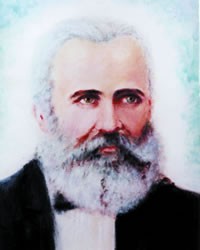
Bezerra de Menezes
I dedicate this article to the noble spirit Dr. Bezerra de Menezes (1831-1900), a respected Brazilian public figure who is worthy of the title he was given of “Doctor of the Poor” and whose birthday we celebrate on August 29. He really knew how to love his fellow beings like few people do.
To love is a law, and, if we live by it, we shall exalt ourselves and renew everything around us. It is similar to an explosion of atoms of harmony, producing enlightenment that will occur with every step we take as we become more mature. To educate is to transform. If we improve human beings, we restore the planet. We know very well, however, that such outcome does not take place overnight. A few millennia are insignificant in terms of historical calculation. It requires effort and patience for minds to mature. If those who preceded us did not believe in the reality of victory ahead of them where would we be? Hope cannot die: ever! Having hope is essential.
Mahatma Gandhi
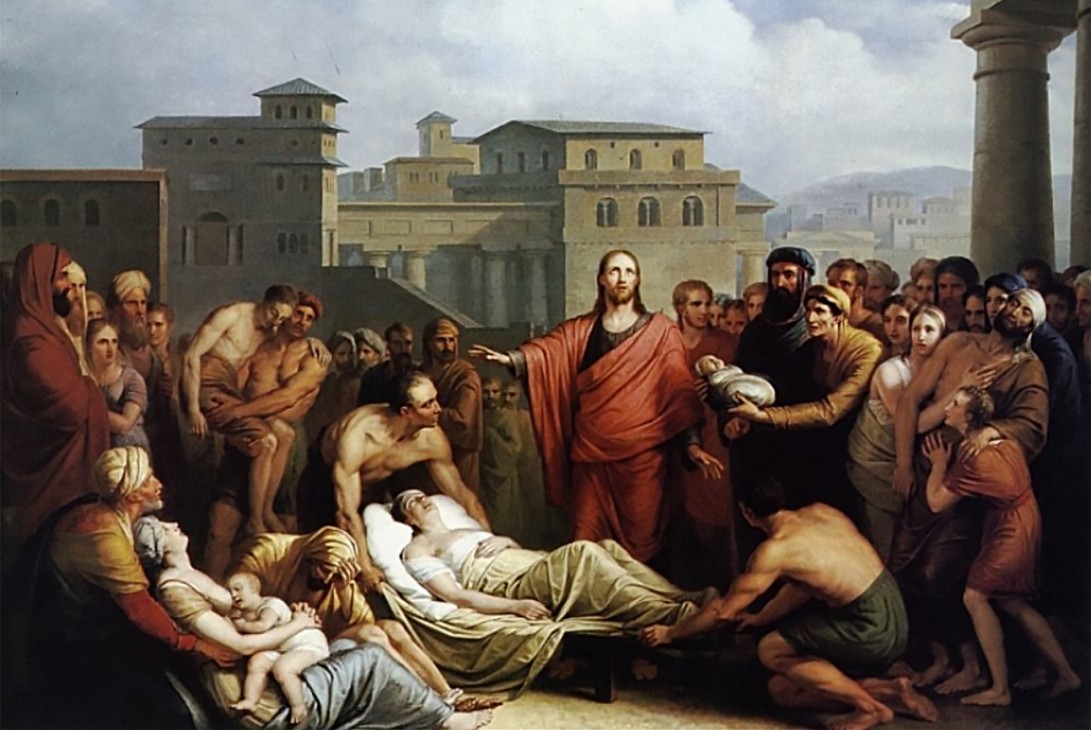
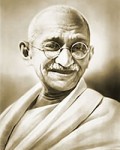
Jesus is the Heavenly Liberator. He assured that if we know the truth—the divine truth of course—it will set us free. Nothing in purely material terms will release citizens from their servitude. No one can imprison the soul of those who have a spiritually free heart. I like to cite the example of Gandhi (1869-1948). He was frequently imprisoned due to his struggle for India’s independence. What did he do in his cold prison cell? He used to write, and his pages constituted the flags of freedom not only for his own people, but also for other nations.
The late Dr. Bezerra rightly taught us: "Complete freedom gives us the awareness of the supreme responsibility we have. . . . Goodness has great strength to expand! . . . People who have faith develop themselves in a moral atmosphere in which they take in the strength they need to fulfill all their duties, the most expansive strength of the joy of the soul, starting from earthly life."
Let us seek planetary coexistence based on Love and mutual respect, without forgetting the sublime concepts of Justice.
Bonifácio, Kennedy, Shaw, and the Invisible World
John Kennedy
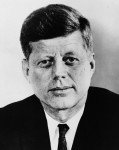
In his speech before Parliament on June 28, 1963, in Dublin, Ireland, John Fitzgerald Kennedy (1917-1963) affirmed that “George Bernard Shaw, speaking as an Irishman, summed up an approach to life: ‘Other people,’ he said, ‘see things and say Why? But I dream things that never were—and I say: Why not?’”
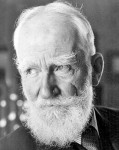
George Bernard Shaw
And as a descendant of Irish immigrants, JFK continued: "It is that quality of the Irish—that remarkable combination of hope, confidence and imagination—that is needed more than ever today. The problems of the world cannot possibly be solved by skeptics or cynics, whose horizons are limited by the obvious realities. We need men who can dream of things that never were, and ask why not."
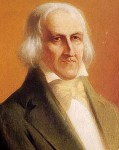
José Bonifácio
These are also qualities of our good Brazilian people, illuminated with hope, no matter how bad the situation may be. At a joyful moment, illustrious José Bonifácio de Andrada e Silva (1763-1838), the Patriarch of Brazil’s Independence, exclaimed: “The Brazilian people are enthusiasts of the beautiful ideal; they are friends of their freedom.”
Having said all these things, it is clear to those who “have eyes to see and ears to hear” that the learning

Isaac Newton
process in this world is still incomplete. The current understanding of Spiritual Life is similar to that of the Universal Law of Gravity developed by Newton (1643-1727), with the later contributions of Einstein (1879-1955). For the sake of argument, we could say that there is no point in denying it, since our contemporary scientific knowledge has still not fully understood all the laws that govern it.

Albert Einstein
Indeed, it is necessary to reiterate this teaching: social reform begins in the Spiritual realm. We have been discussing this point of view and we will develop it further in the course of explaining the Gospel-Apocalypse of Jesus in Spirit and Truth through the prism of His New Commandment, “Love one another as I have loved you.”
The comments do not represent the views of this site and are the sole responsibility of their authors. It denied the inclusion of inappropriate materials that violate the moral, good customs, and/or the rights of others. Learn more at Frequently asked questions.