What Does It Mean to “Offer the Other Cheek”?
From the perspective of divinized Love—which is not to be mistaken for cowardice in the face of injustice and wickedness—I have already spoken to you about that passage from the Gospel of Jesus according to Luke 6:29: “To one who strikes you on the cheek, offer the other also” . . . . This also means we must never tune in to hatred. “Offering the other cheek” is to lead those who try to offend us to the realization that they are committing an outrage against themselves, for hatred is a weapon pointed at the chest of the one who hates. “Offering the other cheek” is an act of courage, an exercise of patience; it is not the attitude of the indifferent or the complacent.
The humble are those who strive to become pure in heart, and so they must be, because they shall see God face to face, as Jesus reveals in the Beatitudes of the Sermon on the Mount—one of the most remarkable pages of the spiritual literature in the world, as I affirmed in As Profecias sem Mistério [The Prophecies Without Mystery] (1998).
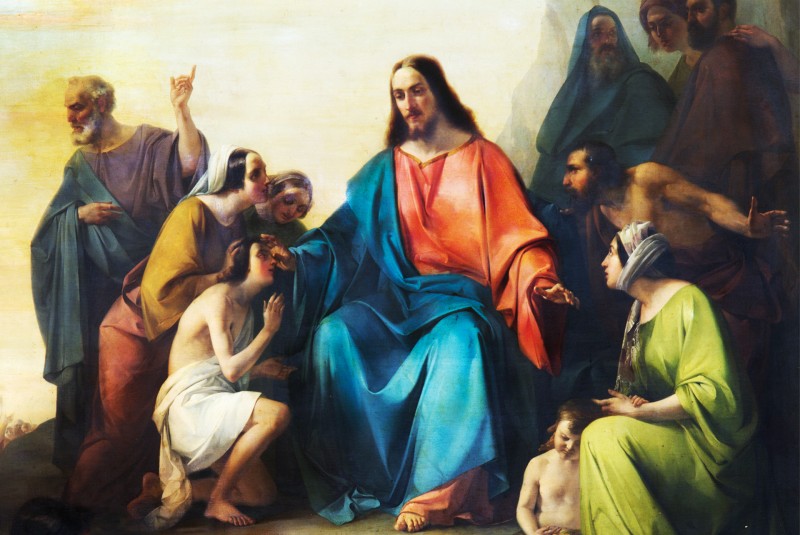
The Holy Bible—because in its prophetic part it is the manifestation of God, who is Love—is therefore sublimely summarized in the New Commandment of Jesus, the Ecumenical Christ, the Divine Statesman: “Love one another, as I have loved you. Only by this shall all of you be recognized as my disciples. . . . There is no greater Love than to lay down one’s life for one’s friends. . . . As the Father has loved me, so have I loved you. Remain in my Love” (The Gospel according to John 13:34 and 35 and 15:13 and 9).

Martin Luther
Whoever truly understands this will come to know the Scriptures, for they were written so that we may reach the fullness of loving one another as the Heavenly Friend loves us. Utopian? One day, it will be the most powerful reality—just as the ever-more-needed kinship of hearts—so much so that His Holiness Pope John Paul II (1920–2005) declared in Fulda, Germany, the homeland of Martin Luther (1483–1546), on November 18, 1980: “Ecumenism is an urgent duty.”
Pope John Paul II
Planet Earth is going through a dramatic phase of profound transition. Those who dismiss the Apocalypse as nonsense or a delirium of the Evangelist-Prophet due to his old age are mistaken. The fact that John was in his nineties, had been whipped, lived as a fugitive, was insulted, slandered, and imprisoned only strengthens the credibility of his testimony before Christ and humanity. Even today’s prisons still leave much to be desired—despite all material progress and the efforts of so many organizations that fight for human rights. Now imagine what it was like in those days when life was worth even less than it is now. Though it is hard to believe life could ever be more disregarded than in a time like ours, when individuals and nations, stupidly, arm themselves more and more. Today, however, there are remarkable institutions dedicated to improving the quality of human life.
Let me take a moment to emphasize that we are deeply concerned with the quality of spiritual life as well—not only for those behind bars, but also for those who, while living outside of them, suffer the gravest injustices.
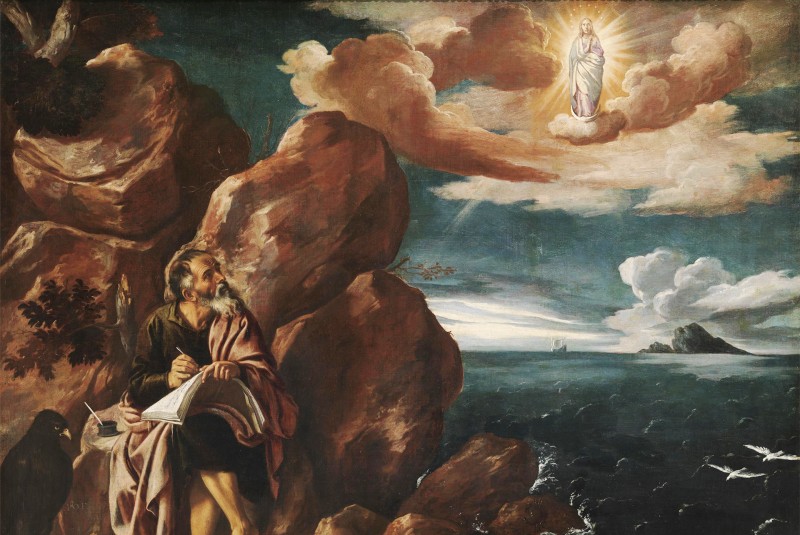
John the Evangelist on Patmos.
It is precisely because the Beloved Disciple endured so much, lived beyond the age of 90, and was no longer bound by material cravings that it became possible for the Greatest Luminaries of the Spiritual World to transmit to him the most important message for personal and collective survival.
As noted by one of those who honor me with their attention and follow this humble work of analyzing biblical texts for the simple-hearted, we are not hastily delving into the Book of Final Prophecies to decipher what the beasts, trumpets, plagues, and many other symbols might be. Everything has its cycle and must follow a progressive path—unless the Soul already carries within itself deep wisdom acquired in previous lives. And even those who possess a more advanced understanding of these matters often choose to start from the beginning—as we are doing with the Bible—so as not to miss the smallest measure of its immense spiritual treasure.

The comments do not represent the views of this site and are the sole responsibility of their authors. It denied the inclusion of inappropriate materials that violate the moral, good customs, and/or the rights of others. Learn more at Frequently asked questions.